

Parti sapphire at a glance
| Species | Corundum with zoned growth, hardness 9 |
|---|---|
| Cause of color | Growth zones with different iron and titanium content |
| Common pairs | Blue and yellow, blue and green, green and yellow |
| Name | Parti, short for particolored |
| Main sources | Australia, Montana (USA), Sri Lanka, Nigeria, Madagascar |
| Check before buying | Zone sharpness, face-up balance, how the cut shows zones |
What is listed right now
Right now the catalog holds 6 parti and bi-color sapphires, from 0.97 to 2.09 ct, and 6 are available to reserve. The most common shapes are cushion, oval, octagon. By the suppliers' own statements, 3 are heated and 3 unheated. 2 listings include a video.
Jump to a shape: Cushion (3), Oval (2), Octagon (1).
How one crystal ends up with two colors
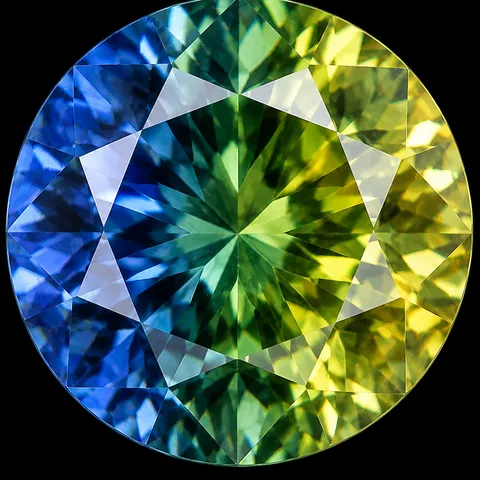
Corundum grows in layers. When the chemistry of the fluid around a growing crystal changes, so does the color of the next layer. Zones rich in iron and titanium turn blue, zones with iron alone turn yellow, and where the two overlap the eye sees green. Most sapphires are cut to hide this zoning; parti stones are cut to show it.
Each one is a record of its own growth, which is why no two look alike and why matching pairs is hard.
Parti, bi-color and teal
Parti is short for particolored, a word for anything with patches of different colors. Bi-color is used when there are two clear colors, often a blue end and a yellow end in an elongated stone. Teal describes a blend, where blue and green mix into one color rather than sitting side by side. Listings keep the supplier's own term, so you may see bicolor, bi-color and parti used for the same kind of stone.
Sources, and Sri Lankan bi-colors
Queensland in Australia is the best known source of parti material, often with strong green and yellow. Montana and Nigeria add smaller, bright crystals. Sri Lankan bi-colors tend to show a blue zone against colorless or yellow areas and are often lighter in tone. Origin is supplier-declared unless an attached report states it.
How the cut changes what you see
The cutter decides what the client sees. Cut with the zones running across the length of an oval or emerald cut, the colors appear as bands from end to end. Cut face-up through the zones, a stone may show one color in the center and another around the edge. Look at the photos and video for both the face-up view and the side, and remember that a deep native cut can concentrate one color.
Zoned stones under different light
Zoned stones change with light in an uneven way. Under warm light the yellow zones glow and the blue darkens; under cool light the blue brightens and the yellow can look pale. A stone that looks balanced in one light may look one-sided in another, so view the photos and video with that in mind and describe the stone to clients honestly as more blue or more yellow.
Designing with parti sapphires
These stones reward simple settings. A bezel or a plain four or six prong mounting lets the zoning do the work, and an elongated shape such as an oval, pear or emerald cut shows the bands best. East-west settings, where the stone lies across the finger, are popular for showing a blue end and a yellow end side by side.
Because every stone is different, designers often build the piece around the stone rather than fitting a stone to a stock mounting. That makes parti sapphires a good match for custom work and for retailers who sell one-of-a-kind pieces.
What makes one stone better than another
The best examples show crisp, well separated zones that are visible face-up, bright colors without gray, and enough clarity that inclusions do not distract from the pattern. Muddy transitions, where the colors mix into a dull green, are less desirable. Size matters as well, since larger stones give the zones more room to show.
Treatment, and selling one-of-a-kind stones
Heating may be used to brighten the blue or yellow zones, and other stones are sold untreated, so check the value on every listing. Unheated is supplier-reported unless a report is attached, and diffusion treated material is listed separately. These stones suit one-of-a-kind engagement rings and statement pieces, where uniqueness is the selling point. Approved retailers can reserve online and show the live stones on their own website through the API.
Questions buyers ask
What is a parti sapphire?
A natural sapphire with two or more distinct colors, typically blue, green and yellow, visible as separate zones in one stone. The name comes from particolored.
Is bi-color sapphire natural?
The color zoning is a natural growth feature of corundum. Treatments such as heating may be applied afterward, so check the treatment value on each listing and any attached report.
Are parti sapphires valuable?
They usually cost less per carat than fine single-color blues or padparadscha, but strong, well defined zoning in clean, larger stones is in demand and priced accordingly. Value rests on how attractive the split looks face-up.
How many parti and bi-color stones are available?
6 stones are listed now, from 0.97 to 2.09 ct. Each has its own photos, so you can see the zones before reserving.
Can I find a matching pair?
True matches are rare because every stone's zoning is different. Use the shape and carat filters to shortlist similar stones and compare their photos.